
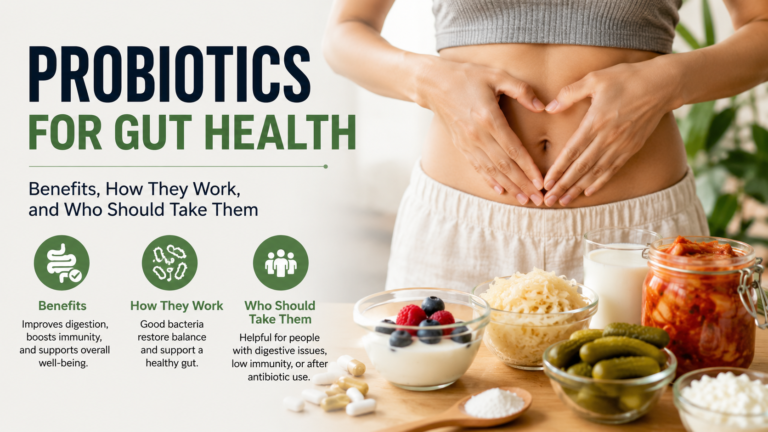
Demand for Probiotics for Gut Health has turned the probiotic industry into a multibillion-dollar market. Despite the hype, many marketing claims are unclear, exaggerated, or simply incorrect. Here’s what years of research—including major scientific reviews through 2025—actually say. Shows that probiotics really can do what they can’t do and what you should know before buying them. You’ve probably seen those ads on TV. The ones for yogurt. The ones for supplements in the pharmacy. Probiotics, for gut health, Boost your immunity ,Fix your digestion.
Here’s what most brands won’t tell you:
Most people spend money on probiotics that don’t actually work. The reason is that not all probiotics are the same. Most don’t last long enough to help you.
What Are Probiotics for Gut Health
Probiotics are live microorganisms mostly beneficial bacteria and some yeasts that are alive and can help keep you healthy if you have enough of them. Your body has trillions of microorganisms in your digestive system, which is also called the gut microbiome ecosystem plays a critical role in digestion helps your body digest food, take in nutrients, work properly and talk to your brain. Every person has different type of microorganism.
If something like being sick, stressed, taking antibiotics or eating poorly throws off the balance of bacteria in your gut, probiotics might help get things back to normal. Common probiotic strains include:
- Lactobacillus
- Bifidobacterium
- Saccharomyces boulardii
- Lactococcus
- Streptococcus thermophilus
Each strain performs different functions, so not all probiotics offer the same benefits
The Four Mechanisms – How Probiotics actually work
Most probiotic marketing talks about benefits, like digestion and immune support. It doesn’t explain how they actually work. Understanding how probiotics work is important. It helps you know what to expect from probiotics. Also it shows why choosing the type of probiotic strain is crucial.
Competitive Exclusion:
Beneficial probiotic bacteria take up the spots on the gut wall that bad microorganisms need to attach to. This crowds out the microorganisms and prevents them from setting in. Probiotics work in this way to help with diarrhea caused by antibiotics and diarrhea you might get while traveling. Probiotics and their effects, on diarrhea are well documented. The beneficial bacteria and probiotics help keep the microorganisms from causing trouble.
Short-Chain Fatty Acid (SCFA) Production:
Probiotic bacteria use fiber from our diet to make short-chain fatty acids, mainly butyrate, propionate and acetate. These fatty acids feed the cells lining our gut reduce swelling help keep the gut wall strong and talk to our system. This is how healthy gut bacteria connect to problems like inflammation and metabolism that affect more, than our gut.
Gut Barrier Reinforcement:
Certain strains upregulate tight junction proteins in the gut epithelium reducing intestinal permeability (sometimes called “leaky gut”). A compromised gut barrier allows bacterial endotoxins into the bloodstream, triggering systemic inflammation. Multiple 2025 studies confirmed this mechanism as central to probiotics’ effects on metabolic and inflammatory diseases.
Immune System Modulation:
Probiotics work with the cells in our gut. They help make more of a protein called secretory IgA. Probiotics also change the way some other proteins work, like the ones that cause inflammation. This helps keep our system in balance. The 2025 Frontiers in Immunology review said that some probiotics are really good at helping our system. They make IgA and help special cells called macrophages do their job better. Probiotics do this by using paths to help our immune system work properly.
Proven Health Benefits of Probiotics
People are doing research on the probiotic benefit for gut health. This research is finding out that probiotics are really good at doing things. The best studies show that probiotics are very effective, in a main area.
Improve Digestive Health:
One of the most well-known benefits of probiotics is supporting digestive function .Certain probiotic strains may help reduce:
- Occasional bloating
- Gas
- Mild constipation
- Some forms of diarrhea
- Digestive discomfort
Restore Gut Balance After Antibiotics:
Antibiotics kill bacteria that make us sick.. They also kill good bacteria that are helpful.When good bacteria get reduced it can cause a problem. This problem is called antibiotic-associated diarrhea.Some studies show that certain probiotics can help. They can lower the risk of getting diarrhea when taking antibiotics. They can also help bring the good bacteria.
Support Immune Health:
Around 70% of the bodys cells are, in the system.A healthy gut microbiome helps the immune system learn to tell stuff from bad germs.Some studies say that probiotics might help with:
- Supporting immune function
- Making some common infections shorter
- Promoting an immune response with the gut microbiome and immune system
Probiotics are not a substitute for getting vaccinated or seeing a doctor, for medical treatment.
May Help Certain Digestive Disorders
Healthcare providers sometimes recommend specific probiotics for conditions such as:
- Irritable Bowel Syndrome (IBS)
- Some cases of infectious diarrhea
- Certain forms of inflammatory bowel disease (as part of broader treatment)
- Traveler’s diarrhea prevention (depending on the strain)
May Improve Lactose Digestion:
People who have lactose intolerance can handle dairy products with certain probiotics in them better than they can handle regular dairy products.
Some of these bacteria actually make the enzyme that helps our bodies digest lactose, in dairy products.
Foods Naturally Rich in Probiotics
Many probiotic foods for digestion that naturally contain beneficial bacteria, including: Yogurt, Kefir, Kimchi, Sauerkraut, Miso, Tempeh, Kombucha (varies by product)
Do You Need a Probiotic Supplement?
Not necessarily. If you are generally healthy and you eat a diet that is rich in fiber and fermented foods your gut may already be well supported by the food you eat. However some people may benefit from taking supplements, including people who have recently completed antibiotic treatment people who experience recurring digestive discomfort people who have specific digestive conditions that they are getting medical guidance, for and people who have difficulty consuming fermented foods. It is important to remember that different probiotic strains serve purposes so probiotics are not all the same.
The biggest probiotic myths, debunked
Myth.
More CFU’s (colony -forming units) means better result
Reality: Clinically evidence for many strains was established at doses of 1-10 billion CFU. Some strains shows no additional benefits Beyond 10 billion. The FDA defination requires “adequate amounts” – not maximum amounts. Higher CFU products often cost more without delivering more benefits.
Myth.
You need to refrigerate all probiotics to keep them alive
Reality: Many modern probiotic supplements use lyophilized (freeze-dried) strains stable at room temperature. The relevant question is whether the product demonstrates viable CFU counts at end of shelf life not simply whether it requires refrigeration.
Myth.
Probiotics are safe for everyone, no exceptions
Reality: For healthy adults, probiotics are generally safe. For immunocompromised patients, critically ill patients, or those with serious underlying conditions, case reports exist of probiotic-associated bacteremia and fungemia – live microorganisms entering the bloodstream. This is rare but not zero risk, and medical consultation matters for vulnerable populations.
Myth.
Yogurt gives you the same benefit as a probiotic supplements
Reality: Fermented foods including yogurt, kefir, kimchi, and sauerkraut support microbiome diversity and provide genuinely beneficial live bacteria – but usually at lower and more variable concentrations than clinical-dose supplements, and typically not of the specifically studied clinical strains. Both have real value, but they aren’t interchangeable.
How to Choose the Best Probiotic
Not all supplements are the same. When choosing a supplement look for these things:
- Clearly identified strains
- Enough CFU
- Quality testing from a party
- Proper storage instructions
- Expiration date with cultures guaranteed
The most important thing is to pick a product that fits your health goal. Don’t just pick one with a lot of bacteria. Choose a product, with the bacteria for your goal.
F.A.Q
Reference Link
Li Y, et al. Research status and development trends of probiotics in clinical applications. Frontiers in Nutrition, Sept 2025. PMC12456187 ↗
· Probiotics and human health: biological activities, nutritional aspects, immunomodulatory properties. Frontiers in Immunology, 2025. frontiersin.org ↗
· Clinical benefits of Bifidobacterium infantis YLGB-1496 in modulating gut microbiota and immunity in young children. 2025 RCT. PMC12812959 ↗
· Park JC, Chang L, Kwon HK, Im SH. Beyond the gut: decoding the gut-immune-brain axis in health and disease. Cell Mol Immunol, 2025. nature.com ↗
· From Gut Dysbiosis to Skin Inflammation in Atopic Dermatitis: Probiotics and the Gut-Skin Axis. Narrative review, PubMed, Dec 2025. PMC12785343 ↗
Key advances in gut microbiome research during 2025. Gut Microbiota for Health, Jan 2026. gutmicrobiotaforhealth.com ↗
Pavlidou E, et al. Clinical Evidence on the Potential Beneficial Effects of Probiotics and Prebiotics in Cardiovascular Disease. IJMS, 2022. PMC9779729 ↗
· Kumar A, et al. Probiotics as modulators of gut-brain axis for cognitive development. Front Pharmacol, 2024. PMID: 38444940


